Inside the ECM — Where the Equations Come From
A ground-up derivation of the 1-RC equivalent circuit model — from physical intuition through KVL and KCL to the analytical solution and its discrete-time form.
Three physical processes, three timescales
When current flows through a lithium-ion cell, three processes activate simultaneously:
Ohmic drop (microseconds) Electrons through metal current collectors and ions through the electrolyte separator encounter resistive friction. The voltage response is instantaneous on any engineering timescale. Modelled by .
Double-layer polarisation (seconds) At each electrode–electrolyte interface, ions rearrange into a charged double layer — physically a capacitor. It charges over seconds and dissipates over seconds when current stops. Modelled by the – parallel branch.
Solid-state diffusion (minutes) Lithium must diffuse through solid electrode particles to the reaction sites. Concentration gradients take minutes to build and minutes to relax. Modelled by a second RC branch (, ) in a 2-RC model.
When none of these are active — after a sufficiently long rest — the terminal voltage equals the Open-Circuit Voltage: a thermodynamic quantity that depends only on lithium stoichiometry, i.e., on SOC.
The Thévenin (1-RC) circuit
The 1-RC model captures ohmic drop and double-layer polarisation:
         R₀              R₁
(+)────/\/\/────────┬────/\/\/────┐────(+)
                    │              │
         OCV(SOC)  C₁    V₁      ═══   V_t
                    │              │
(−)─────────────────┴──────────────┘────(−)
- — series resistance; causes the instantaneous voltage step when current switches on or off
- , in parallel — polarisation branch; the voltage across it evolves continuously
- — terminal voltage; what the voltmeter measures
Sign convention: current is positive on discharge throughout. Fix this and never change it.
Governing equations from KVL and KCL
Eq. A — Terminal voltage (KVL)
Kirchhoff's Voltage Law around the outer loop gives the terminal voltage directly:
This is algebraic — it holds at every instant given OCV, , and . The only quantity with its own dynamics is .
Eq. B — Polarisation voltage (KCL)
Current entering the RC branch splits between and :
Solving for and substituting :
Equations A and B together fully describe the 1-RC ECM. There is nothing else.
Intuition for Eq. B:
- The term: continuously discharges toward zero — the system forgets its past.
- The term: current charges — the system responds to the present input.
- The steady state () is , reached asymptotically at rate .
Analytical solution
Eq. B is a first-order linear ODE with constant coefficients. For piecewise-constant current — constant over any interval — the exact solution is:
Term 1 — initial condition memory: decays exponentially at rate . At it equals ; as it vanishes.
Term 2 — forced response: zero at ; approaches the steady-state value as .
The solution interpolates smoothly from toward , with the transition speed set by . This is exactly the exponential shape visible on every battery voltage trace.
Verification: differentiating the master solution and substituting into Eq. B confirms it satisfies the ODE for all . ✓
Two exact special cases
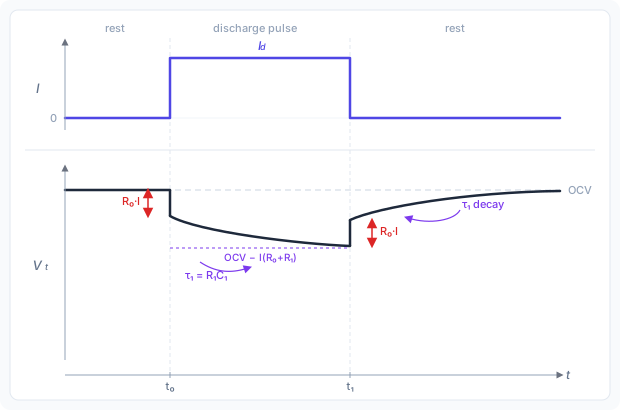
Current applied from rest —
If the cell is fully relaxed before current is applied, the first term vanishes:
At : drops (or rises, for charge) by exactly — instantaneously. The RC branch has not yet responded. then curves further as builds toward . The long-time asymptote, if current were held forever, would be .
Current removed —
With measured from the moment current stops:
jumps immediately by when current switches off (R₀ drop disappears instantly), then recovers exponentially toward OCV as decays. In practice, is unknown — it is what we are trying to find. So the equation is fitted to measured data with two free parameters:
The fit returns and directly. If the pulse was long enough to saturate the RC branch (), then , so
References
-
G. L. Plett, Battery Management Systems, Vol. I: Battery Modeling, Artech House, 2015. — The standard graduate-level reference for ECM derivation, ODE solutions, and Kalman filter SOC estimation.
-
G. L. Plett, "Extended Kalman filtering for battery management systems of LiPB-based HEV battery packs — Part 2: Modeling and identification," Journal of Power Sources, vol. 134, no. 2, pp. 262–276, 2004. — Original paper connecting the ECM discrete update to the EKF prediction step.
-
M. Chen and G. A. Rincon-Mora, "Accurate electrical battery model capable of predicting runtime and I–V performance," IEEE Transactions on Energy Conversion, vol. 21, no. 2, pp. 504–511, 2006. — Widely cited ECM paper; good comparison of topologies.
-
X. Hu, S. Li, and H. Peng, "A comparative study of equivalent circuit models for Li-ion batteries," Journal of Power Sources, vol. 198, pp. 359–367, 2012. — Systematic comparison of Rint, 1-RC, and 2-RC accuracy across SOC and temperature.