Deriving the Bernardi Heat Generation Equation from First Principles
Why Joule heating alone can be off by 20–40% — and how the First Law plus the Nernst equation give the complete picture in two measurable terms.
The Bernardi equation (1985) gives the volumetric heat generation rate of a lithium-ion cell in measurable quantities alone:
| Symbol | Meaning | Units |
|---|---|---|
| Current (positive on discharge) | A | |
| Cell volume | m³ | |
| Open-circuit voltage at current SOC and | V | |
| Terminal voltage under load | V | |
| Cell temperature | K | |
| Entropic coefficient at fixed SOC | V K⁻¹ |
Energy balance
Define the system as the entire cell. Two quantities cross the boundary: electrical work leaves through the load; heat exchanges with the environment. All matter stays inside. The First Law in rate form:
The internal energy splits as . Evaluating requires the reaction rate — moles of lithium transferred per second — which is set by the current.
Faraday's Law. Define:
- mol⁻¹ — Avogadro's number
- C — charge per electron → Faraday constant C mol⁻¹
- — electrons per Li atom (, one electron per formula unit for all Li-ion)
- — moles of Li transferred (variable)
Total charge: . Differentiating ():
Each mole transferred changes chemical energy by (using since for solid/liquid electrodes). Defining (positive because discharge is exothermic, ):
At steady state (), , so . Substitute into Eq. 1 and define :
Heat generated = enthalpy released by reaction − electrical work extracted. is still unknown. The next section expresses it in measurable electrical terms.
in measurable form
Nernst. Define the Gibbs free energy — the portion of a system's energy available to do useful work at constant temperature and pressure. For the discharge reaction, (spontaneous). The Clausius inequality shows the maximum non-PV work the reaction can deliver is . Per mole, electrons flow through , so . Equating:
OCV is Gibbs energy per coulomb — voltage is thermodynamics in electrical units.
Entropic coefficient. The Gibbs relation applied to the reaction gives . Substituting Eq. 5:
The OCV slope with temperature at fixed SOC directly measures — no calorimetry needed.
Enthalpy. Substitute Eq. 5 and Eq. 6 into , then multiply by (Eq. 2); cancels:
All quantities on the right are directly measurable.
The Bernardi equation
Write . Substitute Eq. 7 into Eq. 4 and divide by :
— the overpotential gap is all the voltage lost inside: ohmic resistance, charge-transfer activation, concentration polarisation. Since , this scales as . Always .
— not a dissipation loss. It is the thermodynamically required heat exchange per mole (the Clausius reversible heat). A cell with zero resistance still has it. It scales as , so at low C-rates it dominates the quadratic . Its sign depends on SOC — the same cell can cool the environment at one SOC and heat it at another. Viswanathan et al. (2010) measured at 20–40% of total heat at C/5 and below.
Why changes sign with SOC
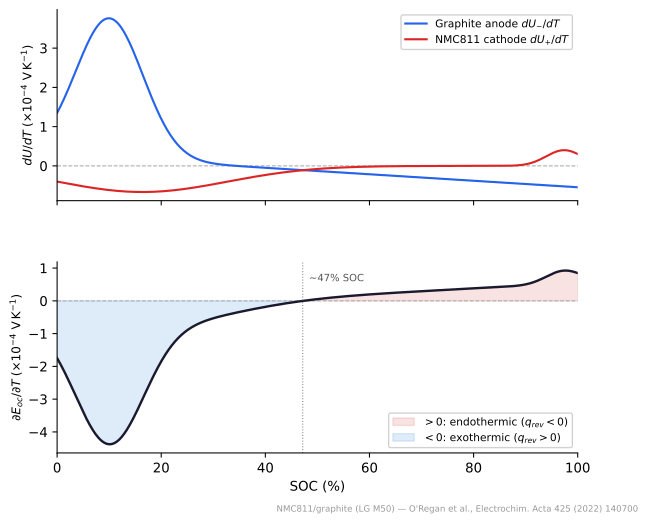
Full cell: . The graphite anode dominates because it intercalates lithium in ordered staging phases — in Stage , Li occupies every -th graphene layer (Stage 4: dilute, ; Stage 3; Stage 2: –; Stage 1: dense, ). Each stage has a distinct configurational entropy.
- 0–47% SOC — graphite is in Stage 4/3 (dilute, disordered). Removing Li collapses disorder sharply → → → (extra heat).
- 47–100% SOC — graphite enters Stage 2/1 (ordered, single-phase). Anode entropy contribution shrinks; NMC cathode (solid-solution, no staging) slightly dominates → → (cell absorbs heat).
Numerical example
18650 NMC/graphite, 1C, 50% SOC, 298 K ( A, m³, V, V, V K⁻¹):
The Joule-only model () gives 23 636 W m⁻³ — a 23% underestimate.
References
- D. M. Bernardi, E. Pawlikowski, J. Newman, "A General Energy Balance for Battery Systems," J. Electrochem. Soc., 132(1), 5–12, 1985. DOI: 10.1149/1.2113792.
- V. V. Viswanathan et al., "Effect of entropy change of lithium intercalation in cathodes and anodes on Li-ion battery thermal management," J. Power Sources, 195(11), 3720–3729, 2010. DOI: 10.1016/j.jpowsour.2009.12.034.
- K. O'Regan, F. Brosa Planella, W. D. Widanage, E. Kendrick, "Thermal-electrochemical parameters of a high energy lithium-ion cylindrical battery," Electrochimica Acta, 425, 140700, 2022. DOI: 10.1016/j.electacta.2022.140700.
- A. Jokar et al., "Evaluation of accuracy for Bernardi equation under pulse-discharge protocols," Appl. Therm. Eng., 201, 117794, 2022. DOI: 10.1016/j.applthermaleng.2021.117794.
- G. L. Plett, Battery Management Systems, Vol. 1, Artech House, 2015.
- J. Newman, K. E. Thomas-Alyea, Electrochemical Systems, 3rd ed., Wiley, 2004.